Bird-of-Paradise Identification: How to Recognize Strelitzia
The commonly photographed bird-of-paradise (Strelitzia reginae) is a South African perennial in the Strelitziaceae family. Strelitzia reginae forms a clump of long-stalked, grey-green paddle leaves and produces orange and blue flowers in succession from a horizontal, boat-shaped spathe. The spathe, tepals, and whole-plant habit are more diagnostic than the name “bird of paradise,” which can also refer to Caesalpinia gilliesii and other plants. Bloom timing depends on light, warmth, age, and climate. A photo can support Strelitzia, but pet safety requires the exact plant record.
Key takeaways
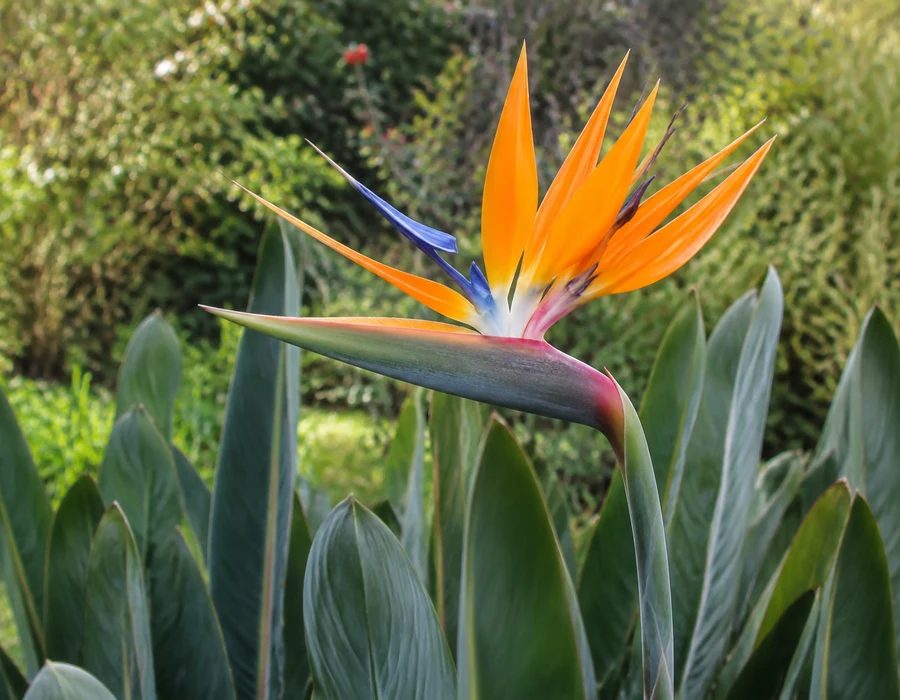
- Orange bird of paradise (Strelitzia reginae) has orange and blue flower parts emerging from a horizontal, boat-shaped spathe.
- Broad, paddle-shaped leaves on long stalks form a clump beneath the distinctive flower display.
- The spathe is a supporting bract, not a petal; include it in a side-view photograph.
- “Bird of paradise” is also used for other plants, including unrelated Caesalpinia, so pair the common name with the scientific name.
- In protected UK cultivation, flowering can occur in winter and spring; light, warmth, and plant maturity affect performance.
How Do You Identify Bird-of-Paradise?
Look for a large clumping plant with broad paddle-shaped leaves on long stalks and a distinctive flower head that emerges from a pointed, boat-like spathe. In Strelitzia reginae, the flowers open in succession and combine three upright orange outer tepals with vivid blue inner tepals. The flower head can resemble a perched bird, but the spathe, color pattern, and whole-plant habit carry the identification.
The Kew Plants of the World Online record for Strelitzia reginae describes its clump, leaves, rhizome, spathe, and tepals. The RHS plant profile describes an evergreen clump with orange and blue flowers emerging from a beak-like spathe.
| Trait | Strelitzia reginae evidence | Why it helps |
|---|---|---|
| Habit | Evergreen perennial forming a clump | A full-plant view separates bird-of-paradise from a single cut flower or a loose annual. |
| Leaves | Long-stalked, broad, oblong to paddle-shaped, grey-green leaves | Leaf size, shape, and clumping pattern remain useful when the plant is not flowering. |
| Flower support | A horizontal green and pink, boat-like spathe | The pointed spathe is a stronger clue than a generic orange flower. |
| Outer tepals | Three upright orange tepals | The orange crest-like elements emerge from the spathe in succession. |
| Inner tepals | Three vivid blue tepals, with two joined in an arrowhead-like structure | The orange and blue combination helps separate Strelitzia reginae from many tropical lookalikes. |
| Underground structure | An underground stem or rhizome | This supports the species description but is normally hidden and should not be excavated for a photograph. |
The common name describes an appearance, not a scientific group. Use Strelitzia reginae only when the visible features fit that species and the image is not showing a different Strelitzia such as the much taller S. nicolai.
Which Visible Features Make Strelitzia Distinctive?
Read the plant from the base upward. A flower-only image can suggest bird-of-paradise, but it may not reveal whether the leaves, spathe, and flower colors agree with S. reginae.
- Start with the clump. Mature plants usually make several long leaf stalks from a shared base. The leaves are broad, smooth-looking, and paddle-shaped rather than finely divided.
- Locate the spathe. The flower head is held above the foliage on a stiff stalk. A horizontal, beak-like or boat-like spathe supports the Strelitzia hypothesis.
- Check the color sequence. Orange outer tepals and blue inner tepals emerge from the spathe as separate flowers open. A yellow-flowered cultivar can occur, so color variation should not erase the structural evidence.
- Look at the flower angle. The tepals project from the spathe in a way that gives the head a bird-like profile. Photograph it from the side as well as from the front.
- Record the leaf condition. Torn leaves can still belong to Strelitzia because wind and handling can split broad blades. Leaf damage is not a different species by itself.
Use the flower anatomy guide when you need to distinguish a tepal from a petal or identify the spathe that supports the flowers. Do not elevate ornamental language such as “bird head” or “tropical” above the structures visible in the image.
Which Flowers Can Resemble Bird-of-Paradise?
The strongest resemblance usually comes from another plant with orange, red, or blue bracts, upright leaves, or a dramatic tropical flower head. Heliconias, cannas, and some ginger relatives can look broadly similar in a garden, while a tall Strelitzia nicolai can be mistaken for the shorter S. reginae when scale is missing from the photograph.
Compare the following before accepting a match:
- Does the plant form a clump of broad paddle leaves, or does it have narrower leaves on a different stem pattern?
- Is there one boat-like spathe with orange and blue tepals, or a layered cluster of bracts and small flowers?
- Does the flower head rise from a stiff stalk above the leaves, or sit inside a leafy stem?
- Is the plant a compact clump or a tall, trunk-like specimen that could be another Strelitzia species?
The name “bird of paradise” also refers to Caesalpinia gilliesii. ASPCA warns that it should not be confused with Strelitzia reginae. For pet safety, check the scientific name and compare the spathe, flower parts, leaves, and whole-plant size.
| Observation | Strelitzia reginae guide | Keep another candidate open when |
|---|---|---|
| Flower support | A horizontal boat-shaped spathe carries the orange and blue floral parts | The showy colour comes from a layered bract cluster without the characteristic spathe |
| Leaves and habit | Broad paddle leaves arise from a clump | Leaves sit on a different stem pattern, or a tall trunk-like habit is the main feature |
| Common name | The name is paired with Strelitzia reginae in a source or plant label | “Bird of paradise” appears alone, especially where a safety fact is being sought |
A dramatic orange flower does not prove that the plant is Strelitzia. A shared common name also does not transfer one plant's pet-safety record to another. If the photograph hides the leaves or plant size, add a full-plant view before choosing a species.
Why Does the Exact Bird-of-Paradise Name Matter?
Once a photo supports Strelitzia, keep the species, growing conditions, and animal species in mind for every follow-up question. Strelitzia reginae is the familiar bird-of-paradise houseplant, but Strelitzia also includes other species with different size and leaf characters. A bloom month or toxicity statement for one species should not be transferred to another plant called bird of paradise.
When and Where Does Strelitzia reginae Bloom?
Kew records Strelitzia reginae as a perennial native to the Cape Provinces and KwaZulu-Natal in South Africa, where it occurs in coastal river-bank and scrub clearings. The RHS growing guide describes the species as tender in the UK, with flowers commonly appearing in winter and spring when plants receive enough warmth and light. Its profile notes that a plant may need to reach substantial size before it flowers.
A plant outdoors in a warm subtropical region may flower differently from one in a conservatory or a dim room. Record the location, light, and species before comparing its flowering time with the flower bloom calendar. A plant without flowers can still be Strelitzia reginae, and flowering during the expected season does not prove the identification.
For a mature, tall plant, include the entire base and canopy in the photograph. That view distinguishes a compact clumping hypothesis from a different Strelitzia growth form before a UK protected-plant bloom record is applied. The same rule protects the calendar from becoming a shortcut for an unresolved houseplant or landscape specimen.
Is Strelitzia reginae Toxic to Cats, Dogs, or People?
The current ASPCA Bird's Tongue Flower record names Strelitzia reginae, also called bird-of-paradise flower or crane flower, and lists it as toxic to cats and dogs. ASPCA gives mild nausea, vomiting, and drowsiness as clinical signs, caused mainly by fruit and seeds. The same record warns that Caesalpinia or Poinciana gilliesii, also sold as bird of paradise, is more toxic.
| Plant named in the record | Cats | Dogs | What the cited record says |
|---|---|---|---|
| Strelitzia reginae | Toxic | Toxic | ASPCA names mild nausea, vomiting, and drowsiness, mainly from fruit and seeds. |
| Caesalpinia gilliesii sold as bird of paradise | Toxic | Toxic | The ASPCA record lists oral irritation, vomiting, diarrhea, swallowing difficulty, and possible incoordination. |
The records above apply to cats and dogs, not people. If a person may have eaten an unknown plant, contact a local poison centre or medical service. If a cat or dog may have chewed a bird-of-paradise plant, contact a veterinarian or animal poison service promptly. Do not wait for image identification. See flowers toxic to cats and flowers toxic to dogs for records arranged by scientific name.
Can a Photo Verify Bird-of-Paradise?
A photo can support Strelitzia reginae when it includes both the whole clump and the unusual flower structure. Send a full-plant view, one leaf with its stalk, the flower head from the side, a front view showing orange and blue tepals, and the spathe where the flowers emerge. Include a scale reference or nearby object when plant height could separate S. reginae from a taller Strelitzia species. Add the country or region for a better growing-condition check.
Use the Flower Identifier to ask whether the plant fits Strelitzia. A careful result should say which structures are visible, flag a possible Caesalpinia or another lookalike, and apply the ASPCA record only when the scientific name matches. It should not call an unknown “bird of paradise” safe, assign a cultivar from colour alone, or turn a dramatic flower shape into a species certainty.