
Daisy Identification: How to Recognize a Common Daisy
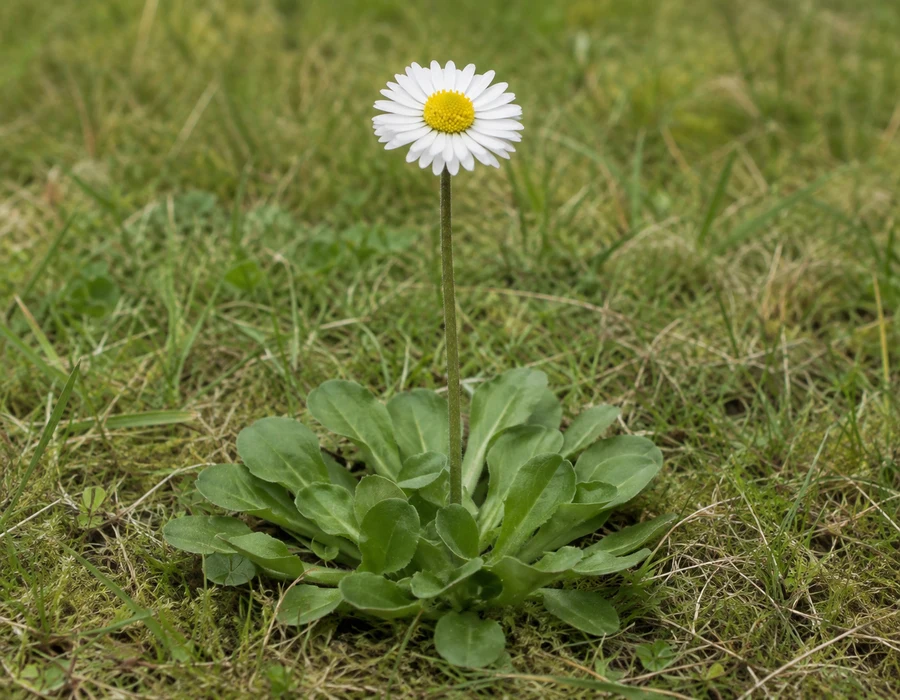
For this guide, “daisy” means common daisy (Bellis perennis), not every flower with white rays and a yellow centre. Common daisy is a low perennial with a basal rosette of spoon-shaped leaves and solitary flower heads. The familiar face is not enough on its own, so compare the plant base, stem, and side view with asters, chamomile, and sunflowers. In the British Isles common daisy flowers across a long spring-to-autumn season, and pet safety requires scientific name-specific checking because “daisy” names unrelated plants.
Key takeaways
- Common daisy (Bellis perennis) has spoon-shaped leaves in a low basal rosette and one flower head on each leafless stalk.
- The white outer rays and yellow centre are separate florets in a composite head, not the petals and centre of one flower.
- Asters have leafy flowering stems; Roman chamomile has finely divided foliage. Check the leaves before naming a white-and-yellow bloom.
- Common daisy can flower from spring into autumn in the British Isles, with occasional winter flowers in mild conditions.
- The common name “daisy” also covers unrelated plants, so records for chrysanthemums do not establish the safety of Bellis perennis.
How Do You Identify a Common Daisy?
Common daisy, Bellis perennis, is a species in the daisy family, Asteraceae. The common name needs care: “daisy” can describe many flowers with a similar white-rayed, yellow-centered appearance. This page uses Bellis perennis as its central plant. A photo that shows only the flower face can support a daisy-like group, but a common daisy identification needs the whole low plant as well.
The most useful combination is a small solitary flower head on a leafless stalk, rising from a flat basal rosette of spoon-shaped leaves. The apparent flower is a composite head. Its golden center contains small disc florets, while the outer white segments are ray florets. The outer rays can show pink or reddish color on the underside, so a front-only image may hide a useful clue.
| Trait | Common daisy, Bellis perennis | Why the trait helps |
|---|---|---|
| Plant base | A compact basal rosette of dark green, spoon-shaped leaves | The leaf rosette shows that the flower stalk rises from the base rather than from a leafy, branching flowering stem. |
| Flower display | One small head carried singly on a leafless stalk | A whole-plant view is needed to confirm that the heads are solitary. |
| Flower head | Yellow central disc florets surrounded by white ray florets | The head is a composite of many small flowers, not one simple flower. |
| Colour detail | White rays can be pink-tinged or flushed beneath | A side or underside photo can preserve a clue that is invisible from the front. |
| Identification covered | Bellis perennis in Asteraceae | The scientific name separates common daisy from other plants called daisies. |
The Royal Horticultural Society profile for Bellis perennis describes the basal rosette and small, solitary flower heads. Kew Plants of the World Online lists Bellis perennis in Asteraceae. Compare your photograph with these structures before treating the common name as settled.
Use a common-daisy check in this order
- Begin at ground level. Look for the compact basal rosette of spoon-shaped leaves. A leafy flowering stem is a reason to widen the comparison before naming common daisy.
- Follow one stalk from base to head. The useful pattern is a leafless stalk carrying one head, not several small heads on a branching stem.
- Read the head as a composite. Check for the yellow disc of small florets and the outer ring of white ray florets instead of trying to count the apparent petals.
- Take the side and underside view. The full stalk, the base of the head, and any pinkish ray underside preserve evidence that a front-facing image can hide.
This sequence gives the plant base and stalk more weight than the familiar flower face. If the first two checks conflict, keep “daisy-like composite” as the working description and compare the leaf-bearing plant before moving to a species name.
Which Daisy Traits Matter More Than White Rays and a Yellow Centre?
White rays and a yellow centre create a useful first impression, but they are not a reliable final test. Many members of Asteraceae can present a similar flower head. Common daisy becomes more convincing when the flower head, leaf arrangement, and low-growing habit all agree in the same plant.
First, inspect the plant base. Common daisy forms a leaf rosette at ground level. Photograph the leaves from above and from the side so the rosette is visible. A photo that shows many leaves spaced along the flowering stem does not match this common-daisy pattern and needs a broader comparison.
Next, check the flowering stalk. A common daisy head is carried singly on a leafless stalk that rises from the rosette. Take a side view that includes the full stalk, the underside of the head, and the nearest leaves. This view can distinguish a low, solitary display from a plant with a leafy, branching flowering stem.
Finally, treat the flower head as a composite structure. The yellow center is made of disc florets, and the white outer ring is made of ray florets. A close front image helps show the two zones. A side image can reveal the pink-tinged underside of rays that some common daisies show. These traits work together. Color alone does not identify the species.
How Do Daisies Differ from Asters, Chamomile, and Sunflowers?
The most dependable way to separate common daisy from a lookalike is to compare the whole plant, not only the white rays and yellow center. Start with the common daisy test: a low basal rosette, leafless stalks, and solitary heads. Then use the comparison that matches the uncertainty in your photo.
Use daisy versus aster when the plant has a daisy-like head but the flowering stems or leaf placement do not clearly match a low rosette. The comparison focuses the question on plant habit and the structures that are visible away from the bloom face.
Use daisy versus chamomile when the flower face looks similar but foliage is the decisive clue. Photograph the leaves and include the point where they join the stem before choosing a name.
Use daisy versus sunflower when a yellow-centered composite head creates the resemblance. Include the whole plant and a side profile of the head so size, habit, and supporting structures can be compared without relying on color.
These pages are not a substitute for observation. They organize the visible differences so you can test a specific alternative. If your photo does not show the plant base or leaves, the best next action is usually another image rather than a stronger claim.
| First observation | Common daisy remains plausible when | Widen the comparison when |
|---|---|---|
| Plant base | Spoon-shaped leaves form a compact basal rosette | Leaves are carried along a flowering stem or the base is not visible |
| Flowering stalk | One head sits on a leafless stalk rising from the rosette | Several heads branch from a leafy stem or the head sits on a tall leafy annual |
| Whole habit | The plant stays low and the head is small in relation to the rosette | The plant is tall, strongly branching, mat-forming with fine foliage, or represented only by a close bloom |
This table provides a starting split, not a substitute for the named comparison page. A flower head with white rays and a yellow centre remains a broad Asteraceae-style observation until the stalk, leaves, and whole plant agree. When a trait conflicts, preserve that conflict in the photo set instead of choosing the common name that feels most familiar.
Once the Flower Looks Like a Daisy, When Does It Bloom and Is It Safe Around Pets?
Once the visible features support common daisy, the next useful questions are flowering time and pet safety. Flowering time changes with region and weather. A pet-safety answer must refer to Bellis perennis, not simply to any plant called a daisy.
When and Where Does a Common Daisy Bloom?
Common daisy is native from Madeira and Europe through the Mediterranean region to Central Asia, according to Kew Plants of the World Online. Kew also records introductions in many other places. A flower found outside this native range therefore needs local context and should not be described as native from a photo alone.
In the British Isles, common daisy has a long flowering season. Oxford University describes flower heads from around mid-March to mid-October, with some plants flowering even in winter. The RHS gives a shorter gardening summary of late spring and summer. Together, these records support a broad spring-to-autumn expectation for that climate, while confirming that local temperature and seasonal conditions affect what is visible at a particular time.
Use the flower bloom calendar to compare cited seasonal records across published species. A date and a region can help narrow a candidate list, but the rosette and solitary flower head remain more useful identification evidence than the month alone.
Is a Common Daisy Toxic to Cats, Dogs, or People?
This page does not assign a cat or dog safety verdict to common daisy, Bellis perennis, from the ASPCA entry titled “Daisy.” The current ASPCA Daisy record names Chrysanthemum species and lists that different scientific name as toxic to cats and dogs. A common-name match is not a scientific-name match.
| Question | Evidence-based answer |
|---|---|
| Does the ASPCA Daisy record identify Bellis perennis? | No. The record identifies Chrysanthemum species. |
| Can the chrysanthemum verdict be applied to common daisy? | No. The entry applies to the scientific name named in the record, not to every plant called daisy. |
| Is a photo enough for a pet-safety decision? | No. Safety needs a reliably identified scientific name and a current, cited animal-specific record. |
For a possible pet exposure, contact a veterinary professional or an appropriate animal poison service promptly. Do not wait for an image result. The cat-safety directory and dog-safety directory should list the scientific name attached to each safety record, so similarly named flowers are not merged into one verdict. This page does not give eating, treatment, or dosage advice for people or animals.
Can a Photo Confirm a Common Daisy?
A photo can support or challenge the common-daisy hypothesis, but a photo does not always confirm Bellis perennis. Begin with a sharp front view of one open head. Then add a full view of the low plant, including the basal rosette, and a side view that shows the leafless stalk and underside of the head.
Use the Flower Identifier to test the question “Is this common daisy, Bellis perennis?” A careful result will separate visible observations from the candidate name, identify a close alternative when one remains plausible, and request the rosette or side view if that is the missing evidence. A result that stays contested is a reason to gather another view, not a reason to force the name.