
Lily Identification: How to Recognize a True Lily
Here, true lily means a plant in the genus Lilium, not every plant sold with “lily” in its common name. True lilies are bulbous perennials with upright leafy stems, usually six petal-like tepals, and terminal flowers that may be trumpet, bowl, funnel, or Turk's cap shaped. Peace lily, calla lily, and daylily belong to different genera and need separate safety records. Bloom timing varies by species, hybrid group, climate, and hemisphere. A photo can support the genus, but it cannot prove a pet-safe result. Check the exact scientific name before acting.
Key takeaways
- True lilies belong to Lilium and usually carry six-tepalled flowers on an upright, leafy stem.
- The leaves grow along the stem, scattered or in whorls, rather than forming only a basal fan.
- Peace lilies and calla lilies have a spathe around a spadix; their shared “lily” name does not make them Lilium.
- Flower orientation, tepal shape, leaf attachment, and stem habit help narrow a lily identification; colour alone does not name a cultivar.
- True lilies commonly flower in summer in UK gardens, with timing varying by species and cultivar.
What Is a True Lily?
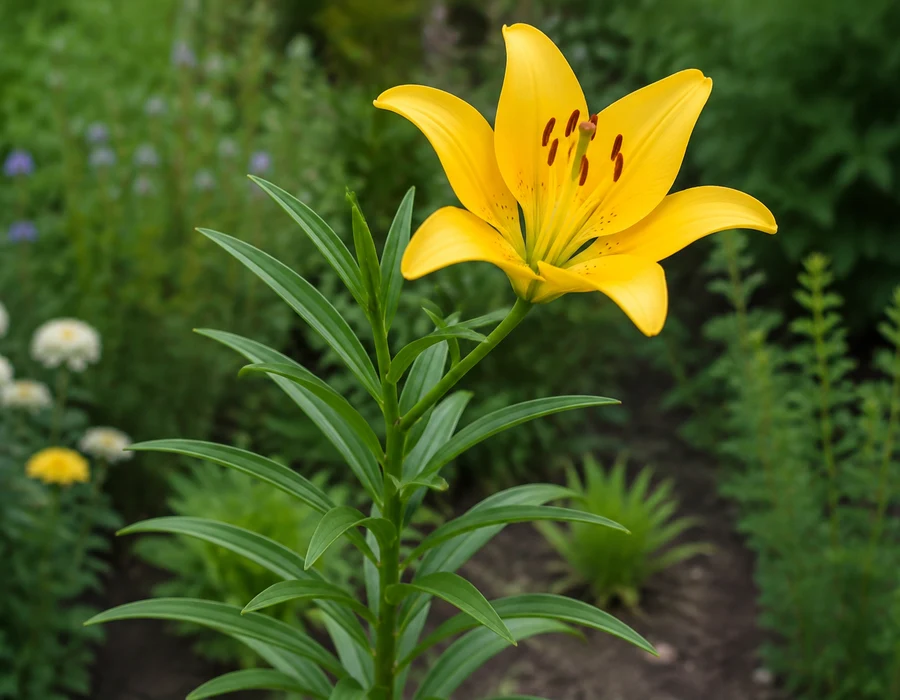
A true lily is a member of the genus Lilium in the family Liliaceae. Kew accepts Lilium as a genus of roughly 100 species, with a range extending across the temperate Northern Hemisphere to the northern Philippines. The plants are erect herbs that arise from bulbs made of overlapping scales. Their leaves grow along the stem, either scattered or in whorls, and their flowers are usually carried in a terminal cluster or sometimes singly.
The Kew Plants of the World Online record describes the genus Lilium and the Kew lily-family page explains its broader family. The RHS lily guide describes common garden flower forms.
| Trait | True-lily evidence | Why it helps |
|---|---|---|
| Underground organ | A bulb formed from many fleshy scales, without a tunic | A scaly bulb supports Lilium when it can be observed safely, but it is usually hidden in a garden photo. |
| Stem and habit | Upright, generally unbranched, leafy stem | A full-plant view separates a lily stem from a leafless flower stalk or a rosette plant. |
| Leaves | Narrow to lance-shaped leaves arranged along the stem, scattered or whorled | Leaf position is more useful than bloom color for distinguishing a true lily. |
| Flower parts | Usually six petal-like tepals in two groups of three | The number and arrangement of tepals help separate Lilium from spathe-based “lilies.” |
| Flower forms | Trumpet, bowl, funnel, or strongly recurved Turk's cap forms | Shape narrows a lily group but does not identify a cultivar from one image. |
| Inflorescence | Terminal raceme, umbel-like cluster, or one terminal flower | The top-of-stem position and flower count add whole-plant context. |
Color, fragrance, and spotting are supporting characters. RHS records lilies in white, yellow, orange, red, pink, and bicolored forms, sometimes with strong scent. Those features are useful for describing a candidate, but they are shared by many cultivated plants and cannot establish a species or hybrid group on their own.
Which Visible Traits Help Identify a True Lily?
Start with the stem and the way leaves attach, then read the flower. A close flower photograph can show a lily-like shape while hiding the bulb, stem, and leaf arrangement that establish the genus.
- Check the whole habit. Look for an upright stem with leaves distributed along it. A plant made only of a basal rosette and a leafless flower stalk is not confirmed as Lilium.
- Count the main flower parts. True lilies usually have six tepals. They may spread outward, form a long tube, or curve strongly backward. The outer and inner tepals can look similar, which is why “six petals” is a useful field phrase but “six tepals” is the more precise term.
- Inspect the flower attachment. Flowers are usually at the top of the leafy stem in a raceme or an umbel-like display. Photograph the side of the stem so the attachment points are visible.
- Record the leaf pattern. Leaves may be alternate, scattered, or in whorls, and they are often narrow or lance-shaped. Note whether the lower and upper stem carry leaves and whether any bulbils appear in leaf axils.
- Describe the form without overnaming. Trumpet, bowl, funnel, and Turk's cap describe visible shape. They do not by themselves prove “Oriental,” “Asiatic,” “Martagon,” or a named cultivar.
The bulb can add useful evidence, but do not dig up an unknown plant just to obtain it. A clear full-stem view, one flower from the side, a face-on flower view, and several leaf nodes usually provide more information with less disturbance. Use the flower anatomy guide when you need to label tepals, anthers, stigma, or a terminal inflorescence accurately.
Which “Lily” Names Describe Different Plants?
The common word lily is used for several unrelated or distantly related plants. That naming habit matters because a visual match and a safety record can change when the scientific genus changes.
| Common name | Scientific group | Visible clue that may differ |
|---|---|---|
| True lily | Lilium species in Liliaceae | Six tepals on an upright leafy stem from a scaly bulb. |
| Peace lily | Spathiphyllum species in Araceae | A white or green spathe surrounds a central spadix; it is not a six-tepal lily flower. |
| Calla lily or arum lily | Zantedeschia species in Araceae | A broad spathe wraps around a finger-like spadix; Kew explicitly describes it as an arum, not a true lily. |
| Daylily | Hemerocallis species in Asphodelaceae | A separate genus with a different family placement and growth pattern. |
Kew lists Spathiphyllum, Zantedeschia, and Hemerocallis as separate genera. Its calla lily profile explains that the familiar “calla lily” is an aroid with a spathe and spadix. These names describe different plants, so do not transfer a pet-safety result from one to another. Once the genus is clear, check the corresponding cat-safety directory or dog-safety directory.
Why Does the Exact Lily Name Matter?
After a photo supports Lilium, keep the genus, species or hybrid group, location, and animal species together. Lily flower forms and dates vary widely across the genus. Pet safety is also unusually sensitive to the exact name because “lily” may refer to a plant from another family with a different toxic principle and clinical pattern.
When and Where Do True Lilies Bloom?
Kew places Lilium across the temperate Northern Hemisphere to the northern Philippines. Within that broad range, species and cultivated groups occupy different habitats and respond differently to temperature, day length, soil, and moisture. The RHS describes lilies as primarily summer-flowering garden bulbs. Its woodland lily guide places some Martagon and species lilies in an earlier June and July window, but those months reflect UK garden conditions and can shift elsewhere.
Those observations cannot be converted into one global bloom calendar. A hybrid grown in a container, a wild species at elevation, and a lily grown in the Southern Hemisphere may open at different times. Use the flower bloom calendar only after the species or horticultural group and the location are known. Bloom date can support an identification, but it cannot overrule a contradictory leaf arrangement or flower structure.
Are True Lilies Toxic to Cats, Dogs, or People?
For true Lilium, the current ASPCA Lily record lists the genus as toxic to cats and non-toxic to dogs, with kidney failure named as the feline clinical sign. That record is not a human medical verdict. RHS also warns that all parts of Lilium are poisonous to cats. This is a high-priority distinction because pollen, leaves, flowers, and other plant material can be involved in an exposure. To check the correct plant, use the cat-safety directory and dog-safety directory after confirming that the plant is actually Lilium.
| Plant | Cats | Dogs | What the cited record says |
|---|---|---|---|
| True lily, Lilium species | Toxic | ASPCA lists non-toxic | ASPCA names kidney failure in cats. The record does not make a human medical assessment. |
| Daylily, Hemerocallis species | Toxic | ASPCA lists non-toxic | The ASPCA daylily record lists vomiting, lethargy, kidney failure, and possible death in cats. |
| Peace lily, Spathiphyllum | Toxic | Toxic | The ASPCA peace lily record describes insoluble calcium oxalates and oral irritation. |
| Calla lily, Zantedeschia aethiopica | Toxic | Toxic | The ASPCA calla lily record describes oral irritation, drooling, vomiting, and difficulty swallowing. |
The table shows why a common name cannot carry a safety result from one plant to another. It also does not provide a human ingestion verdict for an unknown flower. If a person may have chewed or swallowed a lily or a lily-named plant, contact a local poison center or medical service. Do not wait for photo identification. For a possible pet exposure, contact a veterinarian or an animal poison service promptly. This page does not provide treatment, dosage, or home-decontamination instructions.
Can a Photo Verify a True Lily?
A photo can support Lilium when it shows the features that separate a true lily from a spathe-based or daylily lookalike. Send a full-plant view, the stem with several leaf attachments, one flower from the side, a face-on flower view, and the top of the plant where flowers meet the stem. If the bulb is already exposed for ordinary gardening work, a photograph of its scaly structure can add evidence, but do not excavate a plant for this purpose.
Use the Flower Identifier to ask whether the plant fits Lilium. A careful result should state whether the image shows tepals or a spathe and spadix, identify the common-name trap when relevant, and apply cat or dog safety information only to the matching scientific name. It should not call an unknown “lily” safe because the flower is pretty, white, fragrant, or sold under a familiar label.