
Sunflower Identification: How to Recognize a Common Sunflower
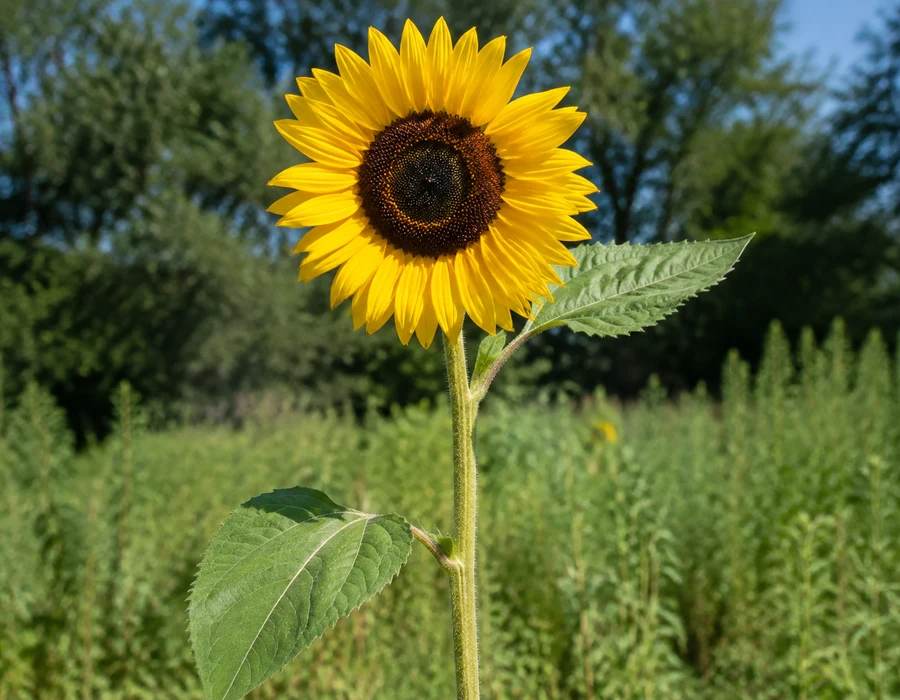
Here, “sunflower” means common sunflower (Helianthus annuus), rather than every plant sold under that label. Common sunflower is an annual Asteraceae plant with a composite flower head, outer yellow ray florets, central disc florets, broad leaves, and an upright habit. The flower face is familiar, but head structure, leaves, stem, and whole-plant scale separate common sunflower from other yellow blooms and common daisy. In UK horticultural conditions common sunflower flowers in summer, while local timing and cultivar traits vary. Pet safety still needs a record for the identified Helianthus species.
Key takeaways
- Common sunflower (Helianthus annuus) is an upright annual with broad, roughly hairy leaves and a composite head of ray and disc florets.
- The lower leaves can be opposite while upper leaves alternate along the stem, so inspect more than one node.
- Wild common sunflowers can branch and carry several heads; cultivated forms are not always single-headed.
- Dwarf cultivars make height an unreliable test. Leaf shape, stem habit, and the flower head should agree.
- In UK garden conditions, common sunflower is a summer-flowering plant; local weather and sowing time affect its schedule.
How Do You Identify a Common Sunflower?
Common sunflower, Helianthus annuus, is a species in Asteraceae. The visible display is a composite flower head, also called a capitulum, rather than one simple flower. Its outer yellow ray florets attract attention, while the central disc contains many smaller fertile florets arranged in a spiral pattern. A close front image can show this structure, but a reliable identification also needs the leaves and the plant's upright form.
The common sunflower is an annual. Wild plants and cultivated varieties do not all look identical. Kew notes that wild forms can branch while cultivated varieties are often unbranched. That variation is why a simple rule such as “one tall stem means sunflower” is not enough. Record what you can see instead: the number of heads, the leaf positions, leaf shape, the surface of the stem, and whether the flower head has a dark central disc.
| Trait | Common sunflower, Helianthus annuus | Why the trait helps |
|---|---|---|
| Flower display | A composite head with yellow ray florets around a brownish disc of many smaller florets | A front view reveals the head structure, not just the yellow colour. |
| Leaves | Broad leaves that are oval to heart-shaped and roughly hairy in the RHS profile | A leaf photo adds evidence that a flower-only image cannot provide. |
| Leaf position | Lower leaves can be opposite, while higher leaves are arranged spirally | Photograph leaves at more than one height instead of assuming one leaf position describes the plant. |
| Habit | An upright annual; wild forms can branch and cultivated forms are often unbranched | The whole plant distinguishes habit from the size of a single head. |
| Identification covered | Helianthus annuus | The scientific name separates common sunflower from other Helianthus species and other yellow composite flowers. |
Kew Plants of the World Online lists Helianthus annuus and describes its head, leaf arrangement, and branching variation. The Royal Horticultural Society profile describes common sunflower as a tall annual with broad, roughly hairy leaves and large flower heads. Use both the head and plant structure before deciding that the plant is common sunflower.
Check a sunflower from the whole plant inward
- Set the scale first. Include the whole plant or a familiar object beside it. A large terminal head is more informative when its size is visible rather than guessed from a tight crop.
- Inspect the disc and rays. A sunflower display is a composite head, with a dark or brownish disc made from many smaller florets and an outer ring of yellow rays.
- Photograph leaves at more than one height. Lower leaves can be opposite while upper leaves are spiral, so one leaf does not represent the whole plant. Broad, rough-textured leaves on an upright annual strengthen the common-sunflower pattern.
- Record branching without turning it into a rule. A wild form can branch while cultivated forms are often unbranched. Branching changes the comparison, but it does not by itself settle the species or cultivar.
This sequence separates a sunflower-scale plant from a smaller yellow composite before colour does the work. If the head is small, the plant is low, or the leaves are missing, start with the yellow blooms guide and keep more than one candidate open.
Which Sunflower Traits Separate It from Other Yellow Blooms?
Yellow is only a starting clue. Many flowers have yellow rays, yellow petals, or yellow composite heads. For common sunflower, the more useful question is whether several traits occur together: a large composite head with a central disc, broad leaves on an upright annual, and the leaf-position pattern that changes from lower to upper stem.
Start at the center of the head. Photograph the disc close enough to show that it contains many individual florets. Then take a side view to show the depth of the head and the structures below it. This pair of images prevents a distant, round yellow blur from being mistaken for a specific sunflower.
Next, photograph the leaves. Include one lower leaf and one higher leaf if possible, together with their attachment points. The lower-to-upper change in leaf arrangement is more useful than a general statement that the plant has green leaves. A broad leaf can also distinguish the common-sunflower hypothesis from a candidate with narrow or finely divided foliage.
Finally, step back. The whole plant shows whether heads are single or multiple, whether the stem branches, and how the flower sits above the foliage. These traits help separate a common sunflower from another yellow member of Asteraceae without pretending that color decides the question. Use the yellow blooms guide when you want to compare other listed yellow forms after recording the plant structure.
How Does a Sunflower Differ from a Daisy?
Common sunflower and common daisy both belong to Asteraceae and both have composite flower heads, so a yellow center and outer rays do not settle the comparison. The plant base and scale provide the useful first contrast. Common daisy, Bellis perennis, forms a low basal rosette with a solitary head on a leafless stalk. Common sunflower has broad leaves along an upright annual stem.
Photograph the whole plant before choosing between the two names. A close front view of the head helps, but it cannot show whether the flower grows from a low leaf rosette or from a tall, leafy stem. The daisy versus sunflower comparison places those observations side by side and helps you ask for the next view when one is missing.
Read the common daisy identification page when the flower is small and low among basal leaves. Use a side profile, leaf photo, and whole-plant image to test the sunflower hypothesis rather than relying on the familiar outline.
The same distinction helps when the flower is a yellow composite but neither name yet fits. A large dark disc and broad leaves keep common sunflower in the comparison. A low basal rosette, one leafless stalk, and a small head point away from common sunflower. Narrow leaves, finely divided foliage, several small heads, or a missing whole-plant view are reasons to use the yellow blooms guide instead of treating a bright yellow face as a sunflower result.
| First separator | Common sunflower remains plausible when | Broaden the comparison when |
|---|---|---|
| Head and centre | The head has outer rays around a broad, visibly composite disc | The visible flower is a simple five-petalled bloom, a tube, or a bell |
| Leaves | Broad leaves can be shown attached at more than one height | Leaves are narrow, finely divided, or absent from the image |
| Plant habit | A whole view supports an upright annual with a substantial head | The plant is low, rosette-based, or represented only by a detached flower |
Why Does the Exact Sunflower Name Matter?
Once the visible features support Helianthus annuus, check flowering time and pet safety using that scientific name. A generic yellow flower or a generic “sunflower” label does not mean common sunflower.
When and Where Do Common Sunflowers Bloom?
Kew records Helianthus annuus as native from the southwestern United States to Mexico and introduced in many other regions. Kew also describes common sunflower as widely cultivated. A sunflower found in a garden, field, or roadside should not be called native or invasive from its appearance alone.
The RHS records common sunflower flowering in summer under UK horticultural conditions. That is useful regional context, not a universal calendar date. Cultivar selection, sowing time, local climate, and growing conditions affect when a plant reaches bloom. Compare a local, cited range through the flower bloom calendar after the species has been identified.
When you record seasonal context, keep cultivated and wild-growing plants separate. A named garden variety and a self-seeded plant can share the species name while reaching the open-flower stage under different local conditions. The month helps rank a correctly limited candidate after the leaf, head, and whole-plant evidence agree. It never repairs a conflict in those visible traits.
Is a Common Sunflower Toxic to Cats, Dogs, or People?
The current ASPCA Sunflower entry covers swamp sunflower, Helianthus angustifolius, and lists it as non-toxic to cats and dogs. It does not cover common sunflower, Helianthus annuus. A safety result applies only to the plant named in the record.
| Question | Evidence-based answer |
|---|---|
| Does the ASPCA Sunflower entry identify Helianthus annuus? | No. It identifies Helianthus angustifolius. |
| Can the record for swamp sunflower establish a verdict for common sunflower? | No. A safety claim needs the scientific name attached to the current record. |
| What is needed for a pet-safety claim? | A reliably identified scientific name and a current, cited animal-specific record. |
For a possible pet exposure or animal illness, contact a veterinary professional or an appropriate animal poison service promptly. Do not wait for a photo result. The cat-safety directory and dog-safety directory should show the scientific name behind each record instead of treating every sunflower common name as interchangeable. This page does not provide eating, treatment, or dosage advice for people or animals.
Can a Photo Verify a Common Sunflower?
A photo can support or challenge a common-sunflower identification, but a photo should include more than the flower face. Add a front view of the composite head, a side view, leaves at different heights, and the full upright plant. These views show the structures that separate common sunflower from other yellow composite flowers and from common daisy.
Use the Flower Identifier to test the question “Does this plant fit common sunflower, Helianthus annuus?” A careful result should describe visible traits, identify a conflicting clue or alternative when needed, and ask for the leaf or whole-plant view that will improve the result. It should not convert a visual candidate into a safety, edible, or regional-status claim.